This article was originally delivered as an address at Parent Orientation on August 20th, 2025.
As we stand at the threshold of another school year at Coram Deo Academy, we’ve chosen a theme that I believe speaks to a deep and often unspoken ache in our culture, in our homes, and in our own hearts. The ache is for relief from all the burdens on our time, the hectic state of our hearts and our minds, and the blur of activities and responsibilities in school, home, work and life. The theme, devised by our own Kim Warman, originally as a proposal for last year, is Restful Minds, Restful Hearts.
Just think about those words for a moment. In a world that seems to be spinning faster every year, a world of endless notifications, overflowing schedules, and the relentless, unspoken pressure to do more, be more, and achieve more, the very idea of rest can feel like a luxury we can’t afford. It can feel like a distant, almost unattainable dream. Oh, that’s a nice idea… maybe someday I’ll get there.
We feel it as adults, don’t we? The constant pull of our phones, the never-ending to-do lists, the feeling of being perpetually behind. And we see it reflected in our children. We see the anxiety that creeps in, the hurried pace of their lives, the sense that they are always on, always performing, always being measured, maybe also always being over-entertained. This is the challenge of what author Cal Newport calls “pseudo-productivity”—the pervasive illusion of accomplishment that comes from being constantly busy, but not necessarily engaged in work that is deep, meaningful, or lasting.
Tonight, I want to diagnose this cultural condition of hurry and distraction, and then, I want to offer a vision for a better, more restful way forward—a way that is not a new invention, but an ancient path that connects deeply to our classical and Christian vision here at Coram Deo Academy.
The Problem: The Tyranny of Pseudo-Productivity
In my own writing, I’ve explored how this culture of pseudo-productivity has quietly infiltrated the modern school, but it’s also invaded our homes and minivans. It’s the educational equivalent of the frantic office worker who spends all day answering emails and attending meetings, only to realize at the end of the day that no truly important work was actually done.
In the world of modern education, this manifests as a focus on “busyness” as a stand-in for learning. It’s the temptation to pack the hours of the school day with what we might call “scholastic filler.” Think of the endless stream of worksheets with single-word answers, the coloring sheets that are more about crowd control than creativity, the entertaining educational videos and flashy, lowest-common-denominator literature that occupy the precious minutes before pick-up. The inevitable outcome of this fast and easy approach is, sadly, low quality and low expectations.
What is lost on many is how all of this low-quality “learning”—what the great educator Charlotte Mason called “twaddle”—is actually harming the development of our children. Consider the difference between a student filling out a pre-packaged worksheet and that same student being asked to write a paragraph or two, in cursive, from their own memory, about a rich story they have just heard. The first is an act of compliance. The second is a complex act of creation, memory, and artistry that hones and develops real intellectual virtue. The first produces a grade; the second helps to form a soul.
So why do we settle for this pseudo-productivity in school? One of the main culprits is what I’ve called the “factory mindset.” In the wake of the industrial revolution, we became obsessed with efficiency, with measurable improvement, and with breaking down every task into its smallest, most repeatable parts. This worked wonders for building cars, but it is a disastrous model for cultivating human beings. The messy, beautiful, and slow work of learning simply cannot be rushed or standardized like an assembly line. Yet we try. We create systems that prioritize easy grading and quick completion over careful judgment and high standards.
This isn’t just an academic problem; it’s a spiritual one. It creates a frenetic, anxious energy that is antithetical to the peace of Christ. This problem was recognized two thousand years ago in a quiet home in Bethany.
In the Gospel of Luke, we read the story of two sisters, Mary and Martha. Christ has come to their home. And Martha, we are told, was “distracted with much serving.” She was busy, she was productive, she was doing good things. She even tries to spread her anxiety to her sister Mary by appealing to Jesus. But Jesus tells her she is “anxious and troubled about many things.” Her heart was not at rest. Mary, on the other hand, “sat at the Lord’s feet and listened to his teaching.” She chose the “good portion,” the one thing that was truly necessary. Our Lord said that would not be taken away from her.
How often do we, as parents, find ourselves living the life of Martha? Anxious and troubled by many things, we fill our days and our children’s days with a flurry of activity, only to find our families spiritually and emotionally exhausted. We long for the peace of Mary, for that unhurried, undistracted, focused attention on what truly matters.
The Invitation: The Restful Path of Slow Productivity
This is the heart of our theme this year. It is an invitation—a gentle and persistent invitation—to step out of the frantic pace of the world and into the restful posture of Mary. It is an invitation to embrace what I, borrowing from Cal Newport, have called “slow productivity in school”—a way of life and learning that values depth over breadth, quality over quantity, and the formation of the soul over the mere performance of tasks.
This is not a call to laziness or to low expectations. On the contrary, it is a call to a more intentional, more focused, and ultimately more fruitful way of learning. It’s about doing the hard, slow work that leads to lasting growth. This philosophy is built on three foundational principles and here I draw explicitly from Cal Newport’s book Slow Productivity, reapplying his three principles to parenting and school.
First, we must do fewer things. This is the classical principle of multum non multa—”much, not many.” In our homes, this means resisting the cultural pressure to overschedule our children, to enroll them in every possible activity. It means protecting the precious, unhurried time for free play, for reading for pleasure, for the boredom that gives birth to creativity. It means giving them margin. As an aside, I just bought Dr. Richard Swenson’s highly recommended book Margin: Restoring Emotional, Physical, Financial and Time Reserves to Overloaded Lives and I would encourage you to dig in to this book or Crazy Busy by Kevin DeYoung, or Slow Productivity by Cal Newport, to follow along with our theme this year. At school, doing fewer things means we give fewer, but richer, assignments. We would rather have a student write one excellent paper, revised and perfected over time, than complete ten mediocre worksheets.
Second, we must work at a natural pace. True, deep learning cannot be rushed. It follows its own organic rhythms, like a plant growing in a garden. It requires seasons of intense effort, but also seasons of quiet contemplation and rest. This is the ancient idea of scholé, the Greek word for “leisure,” from which we get our word “school.” A school should be a place of focused leisure, where students have the time to wrestle with a complex idea, to get lost in a great book, or to patiently work through a difficult proof. We must give our children permission to slow down.
And third, flowing from the first two, we must obsess over quality. This is the ultimate goal. Slowness is not an end in itself; it is the necessary precondition for excellence. We want to cultivate in our students the mindset of a master craftsman—someone who takes deep, personal pride in work done well. This is about teaching them to “throw perfection into all they do,” as Charlotte Mason said, whether it is forming their letters carefully in first grade or crafting a persuasive argument in tenth grade. This focus on quality builds character, fosters diligence, and teaches students that their work is not merely for a grade, but is an offering to God.
These three principles—doing fewer things, working at a natural pace, and obsessing over quality—are not a new management technique. They are a reflection of the very way God has designed us to live. They find their ultimate expression in the person of Jesus Christ himself.
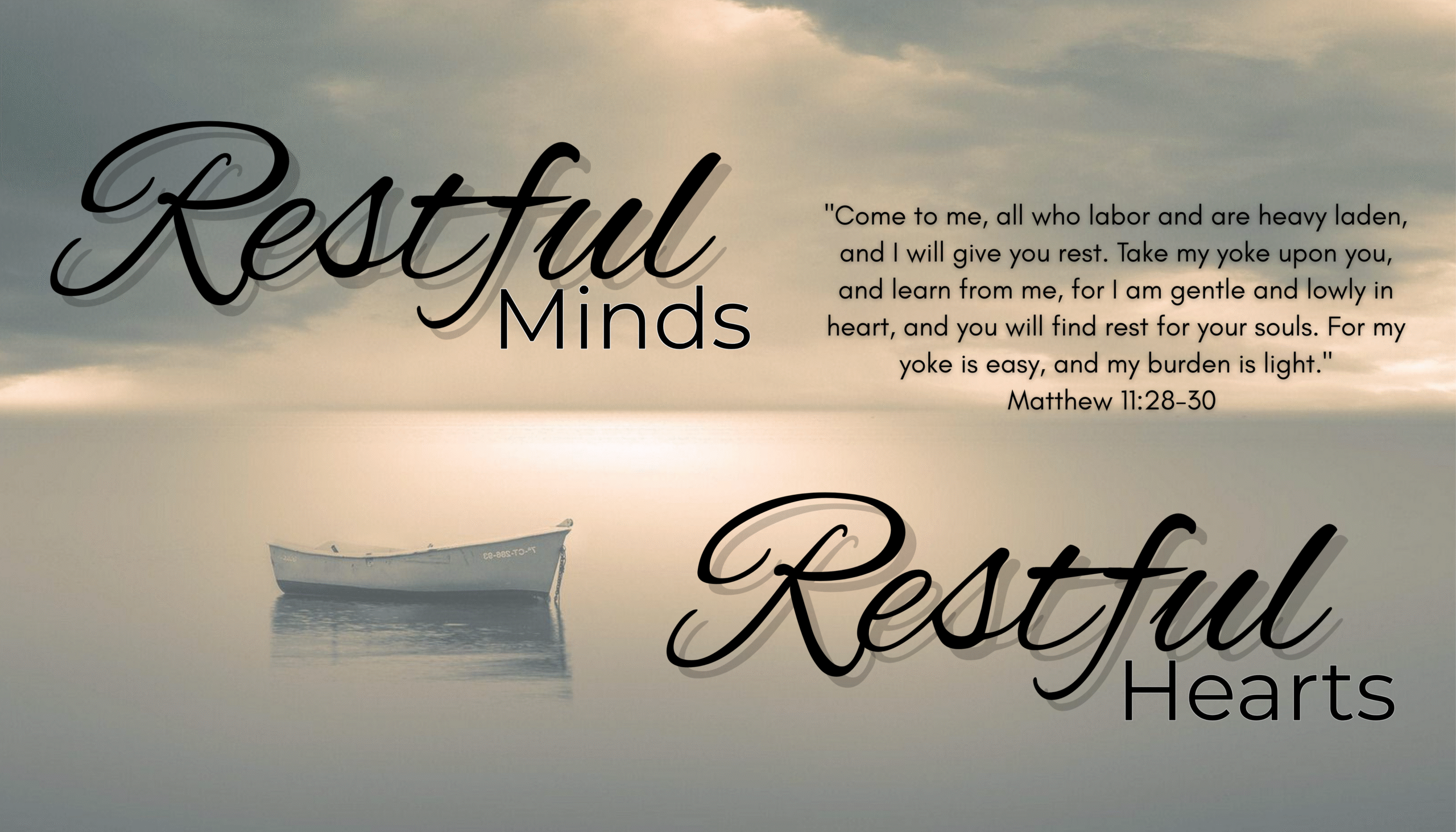
In fact, this is the very invitation that Jesus extends to each of us in the Gospel of Matthew through our theme verse for this year 11:28-30: “Come to me, all who labor and are heavy laden, and I will give you rest. Take my yoke upon you, and learn from me, for I am gentle and lowly in heart, and you will find rest for your souls. For my yoke is easy, and my burden is light.” Jesus’ invitation to rest is paradoxical, because he calls us to take up a yoke, like a beast of burden.
But somehow Christ’s yoke is “easy” and his burden “light.” How can this be? Not because being a student of Christ is without effort or discipline, but because he embodies a way of life that is rightly fitted to our humanity. It is a sustainable, life-giving way of being, free from the crushing, soul-deforming weight of the world’s frantic expectations. It might require us to unplug a little more and take the time to rest in his presence. It might even, ironically, call us to take up our cross and stop avoiding the diligent labor of plowing the field with him. But after all, his yoke holds the rest we seek for our souls; he provides the pattern for the rest we seek for our and our children’s minds.
Our Partnership in Restful Formation
At Coram Deo Academy, this philosophy is not an add-on. It is the very DNA of who we are. We are passionate about spreading a love for what lasts to the next generation and you can’t do that in a hurry. The popular fads of the day might spread quickly, but a deep and abiding love for what is true, and good, and beautiful, for that which has stood the test of time–that takes a more restful and prolonged approach. It also takes a community of parent partnership. We are deeply committed to this partnership. Our teachers will aim every day to create a culture of restful, slow productivity in our classrooms, with the goal of seeing genuine transformation of your students’ hearts and minds.
But for this vision to truly take root, it must be nurtured and reinforced in the culture of your home. This year, let us commit together to push back against the tyranny of the urgent. Let’s choose the “good portion.” Let’s value the quality of our children’s character over the quantity of their accomplishments. Let’s create the space—at school and at home—for restful minds and restful hearts to grow.
Thank you for entrusting your children to us. We are honored to partner with you in this beautiful and important work.