Parent Orientation 2026 – Walking in Wisdom and Virtue
The Art of Deliberation: Training Children for Real Choices
Parents, welcome to the beginning of a new academic year at Coram Deo Academy. Parent Orientation is such a wonderful opportunity to focus our collective vision together as a community of parents and teachers. For this school year, we are grounding our work across both campuses in our annual theme: Walking in Wisdom and Virtue. Our anchor scriptural text is the challenging, two-pronged directive of Christ in Matthew 10:16: “Behold, I am sending you out as sheep in the midst of wolves, so be wise as serpents and innocent as doves.”
Tonight, I want to pull back the curtain on the intellectual and moral machinery required to actually operationalize this command. If we want our children to be wise as serpents and innocent as doves when they leave our doorsteps, we have to look past the superficial metrics of modern education. We cannot simply look at a child as an empty bucket to be filled with information, nor can we treat them as mere pencils to be mechanically sharpened for a workplace slot. A mature classical education targets a far more important—the training of what C.S. Lewis famously termed “men with chests,” where a sharp intellect is dynamically wedded to well-ordered affections, where head and heart are properly attuned to the true, the good, and the beautiful. Tonight I’m going to unpack one piece of that theme under the heading, The Art of Deliberation: Training Children for Real Choices. My main contention is that modern education has carved out the heart of education: the moral center of cultivating practical wisdom. And so, we have to go some way to upend what our culture has assumed about school, in order to help our children learn to make wise choices in the world.
At Coram Deo Academy our very identity is focused on reclaiming this classical and Christian goal. Our mission is “to assist parents in their duty of biblically training their children by offering academic instruction that is distinctly and consistently Christ-centered and classical. Utilizing classical tools of learning and a distinctly Christian worldview approach to education, we desire to graduate young men and women who, as servants of Christ, are equipped spiritually, intellectually and artistically to engage and shape the culture with the claims of the gospel to the glory of God.”
To fulfill this mission, we must recover an essential biblical paradigm for character. Being “spiritually, intellectually, and artistically equipped” entails an education for practical wisdom and virtuous decision-making. True practical wisdom does not arrive in a flash of lightning when a student turns eighteen. It is the fruit of a slow, deliberate process of learning how to seek counsel and practice careful deliberation. Deliberation is an interesting word that we don’t use very often today, but it is an art that is critical for wisdom. We must learn to weigh options carefully in order to choose the best course. Practicing this art must happen both at school and in the home. Tonight, I want to unpack what the art of wise deliberation looks like in the classroom, how it transforms character, and how we must partner together to weave this intentional training into the very fabric of our homes.
I. The Biblical Engine of Counsel
To understand the mechanics of practical wisdom, we must first confront the failure of the modern educational paradigm. For the last several decades, conventional schooling has been captive to frameworks like Bloom’s Taxonomy. You know the ladder: it positions bare cognitive functions—knowledge, comprehension, analysis, synthesis, application—as isolated acts of the mind, as if education were a purely cold, scientific, measurable enterprise. Breaking our educational goals into these micro-steps has enabled the marvel of standardized testing. In a way, this is really helpful. We don’t want to throw the baby out with the bath water here.
But as it is regularly used, this educational paradigm leaves out some very important matters, like life and how you live. A student can do very well on a standardized test, and not know how to live: make terrible personal decisions, act selfishly, not understand interpersonal and relational dynamics. The book of Proverbs would not call such an individual wise. As we say in assembly with the students, non scholae sed vitae, not for school but for life.
Classical Christian education rejects this reduction of education to bare head knowledge. We do not privilege the intellect at the expense of the soul. When Christ demands that we be wise as serpents, he is calling for a baptized prudence—the bridge between what we know to be true and what we do when our choices matter.
Scripture speaks explicitly about how this bridge is built. The book of Proverbs consistently anchors the cultivation of wisdom in the capacity for deliberation and the humility to seek counsel. Proverbs 12:5 tells us that “the counsels of the righteous are justice,” and Proverbs 20:5 reminds us that “counsel in the heart of man is like deep water; but a man of understanding will draw it out.”
Deliberation is the internal counsel of the soul. It is the process by which a person looks at a complex situation, weighs competing options, anticipates moral outcomes, and determines the path that honors God. It is distinct from bare desire. A child can desire to do what is right, but desire alone lacks handles. Deliberation is the calculating engine that asks: “How do I bring about that good end in a way that honors Christ?” If a student does not know how to weigh choices carefully, he does not truly know how to choose. He is simply reacting. Without training in deliberation when our children hit the cultural crosscurrents of contemporary life—when they encounter complex ethical dilemmas or ideological hostility—they will not act with independent moral courage. They become pawns in the contemporary culture war rather than leaders equipped to stand firm before the face of God. Our mission is to ensure they are not pawns, but rather servants of Christ equipped spiritually, intellectually, and artistically to engage and shape the culture with the claims of the gospel.
II. The Classical Tool: Shared Inquiry and a Pedagogy of Deliberation
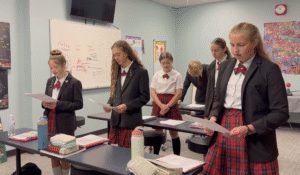
This brings us to the question: How does this look inside the walls of Coram Deo Academy? Our classrooms are intentionally designed as training grounds for corporate and individual deliberation. So, one of the classical tools of learning might be called shared inquiry discussions, socratic seminars, or the teaching method of corporate deliberation. It’s not just that we think students learn better when they are asked questions.
We believe that normal children learn optimally when they are challenged by deep, living ideas that have stood the test of time. Therefore, we pull from primary source documents, the Great Books, and the overarching canopy of Holy Scripture. We look at history and literature not as dead data, but as case studies in moral choice.
When our students encounter the great figures of the Western tradition, they are formulating their own capacity for wise judgment. They observe the micro-deliberations of historical figures. They debate the prudence of tactical decisions in the ancient world; they analyze the tragic moral compromises in literature; they trace the providential hand of God through periods of intense human crisis.
All this is certainly training in language arts, their ability to read and write well, understand their cultural heritage, etc., but it is also something even more important: it is fodder for their development of moral character and wisdom for life.
This training accelerates dramatically through our commitment to Shared Inquiry and Socratic dialogue in the upper grades. In these structured discussions, a teacher does not simply lecture; she guides students through a collaborative wrestling match with a text. Students are forced to listen to alternative perspectives, articulate their reasoning clearly, back up assertions with textual evidence, and self-correct when their logic falters. This is corporate counsel in action. Young adults are learning how to seek understanding together, refining their strategic thinking through iron sharpening iron. This is ultimately what we mean by developing Critical & Creative Thinkers, not just the ability to analyze, but the ability to discern the wise path from a biblical perspective and through the insights of a great tradition of human wisdom.
As students move into the Upper School, this philosophical training gets applied practically through our age-integrated Houses and our Guild system, which will be celebrated this Friday. When our 7th through 12th graders enter their professional Guilds of Modern Rhetoric or lead their corporate Houses as prefects, they are stepping into micro-councils. When a conflict arises between students, or when a House must organize a complex service project, our teacher leadership doesn’t step in to manage every detail. Instead, student leaders are explicitly trained to deliberate. They must meet, process the challenge, resolve relational friction through the grueling work of biblical forgiveness, and calculate how to shepherd the younger students under their care. They are learning that actions have structural consequences, and that leading others requires an exceptional level of personal virtue.
III. The Covenant Partnership: Cultivating Counsel at Home
But this rigorous institutional design cannot succeed in a vacuum. It demands alignment with the culture of your home. This brings us back to our distinctive core of Covenant Parent Partnership. The school is a secondary institution; we exist principally to assist you in your divinely mandated duty of biblically training your children.
Coram Deo Academy is not an educational service provider where you drop your child at the curb, write a tuition check, and delegate the formation of their soul to professionals. Education is a team sport. For this vision of wisdom and virtue to take permanent root, the vocabulary of deliberation must cross the threshold of your front door.
Last year, we focused heavily on pushing back against the cultural trends of digital distraction and frantic hurry. Tonight, I want to address two different, more subtle “enemies” of wisdom and virtue in the modern home that quietly undermine a child’s capacity for independent moral courage.
1. The Enemy of Risk-Aversion and the “Curated” Life
The first subtle enemy we must confront in our modern household cultures is the temptation to build a completely friction-free, risk-averse environment for our children. Out of deep love and protective instinct, it is incredibly easy for us as parents to step in and clear every obstacle out of our children’s paths before they can experience discomfort or failure. We micromanage their relational friction, we manage their schedules perfectly, and we solve their problems before they even have a chance to formulate a question.
When we eliminate all natural friction, we unintentionally rob our children of the opportunity to practice wise deliberation. We teach them to be dependent consumers of our choices rather than independent operators before the face of God. If we want to see them Walking in Wisdom and Virtue, they must first walk on their own two feet.
If a child never faces a genuine moral or practical dilemma appropriate for their age, their intellectual and spiritual muscle memory will remain atrophied. I challenge you to view small hardships, personal disappointments, or relational difficulties not as threats to your child’s happiness, but as the raw material for biblical counsel. When a problem arises, pull your children into the deliberation. Do not simply hand them the solution. Ask the diagnostic questions: What is the core issue here? What does Scripture command? What are the potential consequences of this choice? How do we draw out wise counsel in this scenario? Guide them through the internal calculus of moral reasoning, letting them feel the weight of participating in the decision.
Make your home, your car, and your dinner table a training ground for the art of deliberation.
2. The Enemy of Transactional Performance and External Compliance
The second enemy is the trap of transactional motivation—allowing our homes to operate on a system of external compliance rather than internal heart transformation. In a high-achieving community, it is easy to inadvertently anchor our parental approval, rewards, and linguistic cues entirely around outward markers of success—grades, trophies, test scores, and perfect behavioral conformity.
But wisdom and virtue are internal orientations of the soul. And their true expression can only be found in the grace of the gospel of Jesus Christ. If our parenting relies primarily on external transactional rewards, we train children to ask a shallow question: “What do I get out of this?” rather than “What is the righteous path to walk before the face of God?”
We must ensure our homes are places where character takes priority over mere performance. When your child brings home an assessment, let us intentionally adjust our primary questions. Let us look past the top of the page and ask: “Where did you have to show diligence here? How did you practice craftsmanship? Where did you have to persist when it was difficult?” When they fail or make poor choices, we do not treat it as a catastrophic loss of academic or social status. We treat it as an invitation to sit down, evaluate the misstep calmly without panic or anger, and help them deliberate on how to adjust their habits and decision-making moving forward. This is how we teach them to live before the face of man no longer, but entirely under the resting canopy of an Audience of One.
The British Christian educator Charlotte Mason famously said,
Children should be taught (a) to distinguish between ‘I want’ and ‘I will.’… The great things of life, life itself, are not easy of definition. The Will, we are told, is ‘the sole practical faculty of man.’ But who is to define the Will? We are told again that ‘the Will is the man’; and yet most men go through life without a single definite act of willing. Habit, convention, the customs of the world have done so much for us that we get up, dress, breakfast, follow our morning’s occupations, our later relaxations, without an act of choice. For this much at any rate we know about the will. Its function is to choose, to decide, and there seems to be no doubt that the greater becomes the effort of decision the weaker grows the general will. Opinions are provided for us, we take our principles at second or third hand, our habits are suitable, and convenient, and what more is necessary for a decent and orderly life? But the one achievement possible and necessary for every man is character; and character is as finely wrought metal beaten into shape and beauty by the repeated and accustomed action of will. We who teach should make it clear to ourselves that our aim in education is less conduct than character; conduct may be arrived at, as we have seen, by indirect routes, but it is of value to the world only as it has its source in character.
When we embrace the call of classical Christian education to train our children in the Art of Deliberation, we are building young men and women of Strong Will. When we do so from a biblical worldview, we are forming young men and women of Christian character. And ultimately, we are equipping the next generation spiritually, intellectually, and artistically, not just graduating clever devils. Together let’s embrace the art of deliberation for our children, both at school and at home, and thereby help them develop practical wisdom for all the choices they will face throughout their lives.